무역, 해외 시장 모니터링, 리서치 및 분석.

레이블이 Global Trade인 게시물을 표시합니다. 모든 게시물 표시

2021/02/27

Asia's growth engines set to misfire as post-COVID bounce wears off (Nikkei Asian Review)

팬데믹 이후 경제가 다시 정상화 된다고 하면 인도 10%, 중국 8% 그리고 이머징 국가의 전반적인 경제는 약 7%정도 성장을 할 수 있다는 기대감. (ADB)

하지만 이는 단지 팬더믹 이전 수준으로 되돌아가는 것. 그리고 더 암울하게도 이머징 국가들은 예전 수준만도 못할 것이라는 의문도 있음. 컨버전스로 귀결되는 문제는 항상 개발경제학에서 많이 다루어짐. 빈곤국들은 타 국가들과 경쟁을 하며 성장을 함으로써 부유국으로 수렴할 것이라는 이론이 있음.  하지만 이러한 일이 실제로 일어나지는 않음. 20세기 전반적으로 이머징 국가들은 부채, 인플레이션, 통화 안정 등의 문제를 항상 떠안아야 했고, 선진국들에 비해 성장률이 눈에 띄게 좋지는 않았음.

최근 10년간 기록은 대단했었음. 한 자료에 따르면 이머징 국가들은 1990년과 2000년대에 세계화의 혜택을 보며 고성장을 해왔음. 중국의 가파른 제조업 성장과 더불어 이머징 국가들은 기술 발전으로 인한 글로벌 공급망 역할을 수행함. (분업화) 

하지만 이런 혜택과 호황이 팬더믹 이후 시대에도 지속될 것인가가 의문. 하지만 전망이 그렇게 밝지만은 않음.

사실 COVID 이전에도 컨버전스 패턴이 최근 10년간 후퇴했다는 증거가 있음. 금융위기 이후 전세계가 수요가 감소함에 따라 중국의 근본적인 공급과잉의 문제가 대두. 그에 따라 중국 경제가 과거만큼 초고속 경제 성장의 어려움이 있음. 이는 중국의 커머디티 수요 하락함에 따라 중국의 주변국들의 수출길이 막힘. 1990년 2000년 20년동안의 컨버전스는 매우 이례적임.

미래를 예측하는 것은 불가능하지만, 세계화는 팬더믹 이후에 더딜것으로 예상됨.  팬더믹은 물자와 사람의 국경 너머의 이동이 사실상 어려워지게 함. 미중간 지정학적 마찰을 기점으로 전 세계가 보호무역의 기조로 돌아서고 있음. 특히 중국은 쌍순환 전략을 추진함으로써 미국으로부터 최첨단 기술 의존도에서 벗어나려고 함. 또한 중국의 이웃국가인 인도와의 관계 악화가 양국간 관세 부과로 이어짐. 탈 세계화가 이대로 이어진다면 이머징 국가들의 경제 부상은 어려워지게 됨.

다행히, 아시아 이머징 국가들은 타 대륙에 비해 상황은 좋은 편. 특히 글로벌기업들의 공장의 다각화는 중국 인근의 국가들에 수혜를 줌.  또한 중국의 소비 경제가 약간 증가함에 따라 수입이 증가. 

컨버전스는 빈곤국과 부유국과 경쟁 구도가 될 수 있음. 선진국들은 과도한 재정지출로 인한 엄청난 부채를 떠안고 있음. 하지만 이머징 국가들은 지출을 덜 하는 대신 개혁을 함. (Ruchir Sharma는 이러한 정책이 이머징 국가 전망을 더 밝게 한다고 얘기함)

하지만 세계 경제는 매우 복잡해짐. 트렌드는 제조업에서 디지털 서비스로 프레임이 전환중이고 자동화의 발달로 저렴한 노동력이 더 이상 필요가 없어질 뿐더러 더욱 숙련된 노동력이 요구됨. 이는 2차산업 제조업을 하는 국가들에게는 고민해야할 숙제임.


출처

https://asia.nikkei.com/Opinion/Asia-s-growth-engines-set-to-misfire-as-post-COVID-bounce-wears-off

2020/11/08

How will Biden Administration affect global trade?

Joe Biden (Democratic Party) was selected as US president in November 2020. U.S economy has been stagnant since the emergence of COVID-19, which diminished purchase power of overseas supplies. However, if the US economy recovers as economic stimulus measures reach agreement, the demand from U.S. consumers will increase, which is good news for global economy and trade. Nevertheless, due to the increase in monetary base and the velocity of dollar supply, it is highly likely that Biden's major pledges will act as a pressure to appreciate other currencies (only Turkish Lira is depreciating its value). There is also high possibility that Biden will maintain a strong policy toward China to protect U.S. industries, which is in need for other countries to monitor and prepare.

Dealing with China

Similar to the previous Trump administration's trade policy, Biden administration will also show strong stance towards China in terms of trade through strengthening solidarity with the alliance. It is expected to respond strongly to unfair trade practices in China in collaboration with allies and expand to areas such as human rights, labor, and the environment (climate change).

Protective Trade Measures

The possibility of withdrawing tariffs against China and Article 232 measures imposed by the Trump administration is expected to be low, and import regulatory measures such as anti-dumping and countervailing duties are expected to continue to protect domestic industries.

Trade Agreement 

It is a position that it will not proceed with a new trade agreement immediately after election, and even if a trade agreement is promoted, there is a high possibility that the Democratic Party will demand strengthening of requirements such as labor and environment provisions traditionally emphasized.

These three factors are the position that the United States will lead the world trade order and rebuild the leadership of the United States through multilateralism and restoration of trust with allies.

How will these affect to the global trade? The recovery of the US economy through expansion of stimulus package and rules-based trade policy are expected to have a positive effect on global trade, but there is a need for continuous monitoring of disputes between the US and China and fluctuations in exchange rates and oil prices, and protective trade measures (Buy American). 

To conclude the existing concept of US-China conflict remain unchanged. Unlike Trump's unpredictable and extreme tariff wars, trade policy with China is likely to become an imprisonment for China through coalitions with allies. Therefore, the trade dependent country like Japan, Korea and Taiwan should pay close attention to Biden's economic pledges and the process of industrial protection policies.


2020/10/20

China halts Australian coal imports due to political conflict.

China is struggling with Australia over coals and cottons. China is taking a series of 'retaliation measures' against Australia after Australia began seeking support from European leaders for an investigation into China’s response to the pandemic. 

Chinese authorities have recently taken steps to virtually halt imports of Australian beef, wine, barley, and recently coal. Now Chinese government is reportedly targeting Australian cotton as well as the target of retaliation according to South China Morning Post. 

Australia’s economy is now under heavy pressure of lockdowns in the country’s second-largest city with its international border closed. According to WSJ, Australia is experiencing its first recession in 28 years. Australia has experience in avoiding global financial crisis hit a dozen years ago thanks in part to China’s stimulus efforts on its infrastructure expenditures which needed Australian iron ore and other minerals to build bridges and skyscrapers.

For the past decade, China has been Australia's largest trading partner and now accounts for 32.6% of its exports. China selected Australia as strategic partner over its rival Brazil for importing Australia's mines such as iron ore, coal and gas which fueled China's growth.  Australia is preferred for their quality and geographic proximity. The deal benefits both nations.

China has already delayed Australia’s iron ore custom clearance in April due to conflict with Australia over the issue of the COVID-19 virus. Commodity experts predict that it will be difficult for China to impose additional import sanctions on Australian iron ore since 60 percent of China’s mining is imported from Australia. There will be sharp rise in iron ore prices if China continues to ban imports of Australian iron ore.


Source

https://www.wsj.com/articles/china-sentences-australian-to-death-as-bilateral-relations-fray-11592045994

https://www.wsj.com/articles/australia-worries-coal-is-chinas-next-target-as-ties-fray-11602665386

https://www.wsj.com/articles/chinas-economic-squeeze-on-australia-extends-to-cotton-11602839413

Increase in global shipment as rebounds on demand surge. [Pandemic restocking]

Idle vessels increased to 2.7 million TEU in May of this year due to the plunge in demand of the onset of the great lockdown but have recently decreased its laid-up vessels to 430,000 TEU, according to Alpha Liner. The container shipping companies reduced supply of shipping services in preparation for deteriorating container transportation demand in 2nd quarter, increasing the proportion of idle ships to 11.6% of total fleets. 

However, as the lockdowns are starting to ease (lifting the blockade), the demand of trade is surging, filling up container ships across the Pacific and operators are restoring cargo-vessel sailings that were cut by as much as a third at the height of the pandemic closures from March to June.

Increased demand is believed to be due to the reason below.

1. Increased demand for medical products as people starts to consider their healthcare.

2. The conversion of some air cargo to maritime cargo. 

3. The conversion of expenditure of the service sector due to Corona 19 into consumable goods.

Moreover, WSJ indicates, shipping executives pin much of the rebound on e-commerce. “The service industries are still paying the price of the lockdowns but there is a surge in online shopping,” said Mikkel Elbek Linnet, a spokesman for Denmark’s A.P. Moller-Maersk A/S, the world’s biggest container operator. “People may not go out for a drink, but they will spend money on a pair of sneakers or to get home appliances.” 

The rebound in demand has pushed up freight rates since U.S is restocking its depleted stocks ahead of holiday season. Please see my blog. 

https://techongstudy.blogspot.com/2020/08/container-shipping-companies-create.html

If demand growth continues in fourth quarter, vessel supply can increase both ocean and air.  The current low fuel price is expected to have a positive impact on shipping firm’s profit.


Source: WSJ, FT

https://www.wsj.com/articles/container-volumes-shipped-to-the-u-s-surge-after-coronavirus-downturn-11599240926

https://www.ft.com/content/4a77fe08-edb4-46b6-a030-f32a404ccdce

2020/10/19

Why is economy of Singapore in near crisis.

Singapore's economic is in crisis. The growth in second quarter of 2019 was negative 3.3% which was the lowest in seven years. Non-oil exports shrank 17% compared to the same period last year. Retail sales plunged 8.9% for five consecutive months, car sales shrank 32%, furniture and home appliances fell 15%, computers and technology equipment plummet over 7%, which were the signs of a fall of durable goods. The aftermath of the recession was quickly transmitted to the corporates and led to the cases where the corporate bond transactions have halted. Unprecedented recession has taken over Singapore economy recently.


Singapore is one of the richest countries in Asia. The population of Singapore is about 5.5 million, but it is enough to be the 20th largest economy in the world. Port of Singapore was the world largest trading port (later it was overtaken by Shanghai Port) as a center of transit trade taking advantage of its geological location connecting the Indian Ocean and the Pacific Ocean. And as the world's number one transshipment port, the transshipment volume is responsible about for 20% of the world's transshipment cargo.

Singapore can be regarded to be an economy in which exports and imports are taking over the most part. Singapore's import and export volume exceeds 200% of its gross domestic product. Singapore economy is showing a marked decline in 2019. Since, Singapore's largest trading partner is China, the downturn in China's economy and the outcome of the US-China trade dispute are hurting economy of Singapore directly. Singapore has also served as a financial hub and a gateway to investment in Chinese companies. Indeed, many Chinese real estate developers have raised enormous amounts of financing from Singaporean banks. However, some of which are now in default, which is a factor holding back Singapore's economic growth.

Singapore economy grew through a dictatorship under the leader of Lee Kuan Yew and took advantage of strategic ally of the United States. Also, the economy benefited from globalization for the past 40 years and China’s economic reform. However, while Japan, Korea, and Taiwan have achieved remarkable industrial leaps from automobiles, shipbuilding industry, electronics, and semiconductors. Meanwhile Singapore is mainly focusing on finance, services, and software.

It should be noted that the countermeasures of economic policy makers can create a discriminatory response amid concerns about how the decline in global trade volume due to de-globalization and the US-China trade dispute will have an adverse impact on Singapore's economy.


Source: Big Hit


2020/09/08

International trade tips for individual resellers (How global trade works)

World trade is becoming more simple and easy.
Trading globally does not mean full 40’ standard high cube container volume transaction between two conglomerates. Until 2000s, trade had been a very high entry barrier. Massive budget was essential to win a contract from other party by arranging an international business trip or attending an international fair. However, as the internet develops, more information was shared globally. Upgrades on finance technology has helped to reduce the burden of traditional global payments such as telegraphic transfer by banks, letter of credit, or collection basis (D/A, D/P). The development of logistics services of e-commerce platforms has made small volume trade easier. Anyone can participate in global trade field without substantial expenses. To know more about the process please check the factors below.


Trade documents
The papers contains payment and shipping-related documents issued directly or indirectly by importers and exporters, mostly in the course of paying to exporters and delivering goods to importers under a trade contract.

Trade documents are mainly composed of Bill of Lading (B/L) when the products are about to be shipped, commercial Invoice (C/I), and packing list (P/L) from consignor’s side. purchase order (P/O) or letter of intention (LOI) is issued by buyers when ordering, proforma invoice (P/I) is written by exporters when presenting the quotation. Sometimes certificates of origin (C/O), material safety data sheet (MSDS), etc. are needed during the process of custom clearance and quarantine sanitation. When the products are delivered by air, then the shipping company issues airway bill (AWB).
 

Payment
There are various payment methods. The payment can be through bank using telegraphic transfer (T/T) service, or letter of credit (L/C) when exporters are not reliable enough to pass the goods safely door to door, and collection base such as document against payment or acceptance. As fintech improves, paying through online became one of the means for global trade. Paypal, Payoneer, Union Pay, etc are the example of finance technology.

Then what method should buyers choose to do the payment? Well it depends, if small orders, then I prefer Paypal, but if the order increase, then telegraphic transfer is another method. When selecting payment as Paypal, then 100% payment in advance is recommended since the commission fee is high (approximately 3%) and the orders are small. If order starts to get bigger, then I recommend doing telegraphic transfer. Buyers can pay 30%-50% of down payment for safety, and when the products are ready to be shipped, the rest can be paid afterwards. Remained balance payment can be decided depending on the situation such as an issue of check B/L or other materials that can prove the safety of shipment.

If the seller is extremely unreliable, then I recommend L/C usance or D/A. In cases of most frontier countries, advising bank can be untrustworthy as well, T/T after 00 days of invoice might be the safest method during international trade. Payment method should be negotiated carefully.


Shipment
Delivery of goods varies on gross weight and volume of the product.

1) Air: couriers such as Fedex (TNT), DHL, UPS, EMS
Shipping cost is calculated on the volume and gross weight. Larger amount the consignee import, more charges it would cost. It is recommended to small amount orders since the cost can be extremely high that buyers cannot afford and the delivery lead time can be shortened. (It takes about 3-5 days in most of the countries) Most of the packings are in cartons or boxes.

2) Ocean: logistic (shipping) companies
Shipping cost depends on cubic meter (CBM) and gross weight. CBM is the size of the volume (length x width x height). If it is over 1 CBM, then the shipping cost will be cheaper. Most the transaction goods are packed in pallet when buyer prefers less than container load (LCL), or full container load (FCL) when total amount is over 10 pallets. Lead time can take from 2 weeks to more than a month depending on the distance.


Incoterms 2020
The terms are used to specify who is in charge of the shipping cost and custom clearance fee. It also includes who is applying for the insurance during the shipment. There are total of 11 terms, three terms are used widely during global trade.

EXW (Air)
It refers to the sellers (or also regarded as shippers) handing over contracted product from their factory or warehouse to the buyer (or also considered as consignee). The seller has minimum obligation, on the other hand, buyer covers all costs and organizes transport. (Buyer takes responsibility from seller's factory) Convenient condition for exporters who are not familiar with trade transactions since buyers takes own risk and cost for carrying out all the trade process. EXW is proceeded when seller is in A's position and buyer is in B's position.

FOB (Ocean)
It is the most commonly used condition with CIF in practice. The divergence of risk and cost ends when the seller puts the goods on board of the buyer's nominated ship. Subsequent risks and additional costs are all up to the buyers. They have the right to sign the nomination of vessel (frieght forwarder) and the contract of carriage, and at the same time bear all costs such as freight and insurance to the destination (port).

CIF (Ocean)
Seller's Cost: CFR + Sea Insurance Fee
Under the CIF terms, if there is no agreement for insurance between each other. The seller must pay for insurance. When signing an insurance contract, the policyholder and the insured are the sellers, but after the transaction begins and the goods are shipped, the insured becomes the buyer. The rules dealing with the rights and obligations of the parties under the CIF are the Warsaw-Oxford Rule-Waluso-Oxford Rules. If CIF is changed to a combined transport method, it becomes CIP.

To see more Incoterms 2020, please check my blog.


Custom Clearance
It depends on the countries, since they have different laws and regulation. There are several reasons for it; to protect their manufacture industry or to screen the products’ safety when their nation use it. To say in common, cosmetics, foods, medical cares, electronics with electromagnetic waves are the subject to be examined during custom clearance. Small quantities of samples are not the problem to import or export. On the other hand, mass amounts of products may encounter problem when entering custom regulations. Even though the products are extremely safe in manufacturing countries, consignees still need to acquire foods and drugs administration (FDA).

To proceed FDA, exporters can help by sending ingredient list or MSDS. If importers want to reduce tariffs, then C/O is required. If buyers do not like to involve in complicated process, or manufacturing companies do not want to reveal their ingredient, there is method of shipping separately by dividing partially in different consecutive days. Using countries which has less custom regulation is another methods, such as Hongkong, Singapore, and Dubai.

2020/08/31

Container-shipping companies create profit despite Covid-19 recession.

The increase in freight rates have benefited shipping companies for more profitd. It is due to the reduction of fleet supply and volume. Even though economic downturn was forecasted due to low demand of global trade, economic slowdown did not lead to the deterioration of the profits of container ship operators.

In the past, during the 2008 financial crisis, the profitability deteriorated significantly due to deliberate price fall responding on low demand. However, in response of Covid-19, shipping companies operated capacity adjustment instead of price slashing which later triggers profit rise when there is demand for it. Shares rise aftermath.
Source: Shipping Stocks Weather the Pandemic Storm 
https://www.wsj.com/articles/shipping-stocks-weather-the-pandemic-storm-11598868003

2020/08/26

Cross-Boarder Trade when exporting to China. (跨境)

Chinese government started levying excise tax on foreign consumer starting from January 1st, 2019. This is new policy called 跨境, which is China's own cross-border trading. CBT is to replace The rise in Chinese CBT is originated as platforms such as Alibaba, Kaola, JD are developing infrastructure of e-commerce system from fin-tech to delivery. This system is to ease regulation of general trade and it is form of new and legal trade. There are four benefits using CBT in trade with China.

1. Fighting with smugglers
The Chinese government has to impose tariffs on cross-border logistics transactions, but smugglers are interrupting it. The government wants to get rid of them by strictly regulating to those parties who did not register as an official business.
Therefore, the Chinese government designated CBT possible product lists and levied unified tax rates of 9.1% by registering as a white list and minimizing customs clearance lists.

2. Logistics
CBT transaction method is divided into individual special delivery and bonded area. It can be selected according to volume of transaction, enabling more efficient operation and management of logistics costs.

3. Risk hedge
Items must have FDA such as CIQ during general trade method (bulk trade) but CBT do not require authorization since it is traded in small amount. Unlicensed products are allowed in small amount.

4. Security
Since CBT is permitted by government, it has a safe transaction management of buyer information, payment method, and delivery detail.

Understanding of CBT (Cross-Boarder Trade)

CBT exists in countries of borders, act of the buying and selling of goods and services between businesses in neighboring countries. CBT is beneficial for reduction of excise tax by buying consumer products from countries with low regulation of tax.

EU
Europe has many countries; CBT is crucial in EU area. Borders between Ukraine and Russia, between Norway and Denmark/Sweden/Finland/Russia/Estonia, between Denmark/Switzerland and Germany, and between Lituania and Poland benefit from CBT.

For example, the tax on alchohol is very low in Estonia than in FInland and Sweden. It is common to purchase massive alcohol from Estonia when returning to their countries. Other examples are down below in EU.

Lithuania - Poland : Food (Poland is cheaper)
Northern Ireland - Republic of Ireland (Petrol is cheaper in the Republic, where as groceries, furniture and clothing are cheaper than in Northern Ireland.
Netherlands - Belgium, Germany, France: Marijuana trade
U.K - France/Belgium: Brooze cruise (Alcohol, tobacco, etc)

North America
Cross-border trading between three countries in Canada, Mexico, and the United States is robust. The North American Free Trade Agreement (NAFTA) has reduced barriers and tariffs, facilitating cross-border trade. Each day from 2008, $2 billion of cross-border trade was conducted between Canada and the United States alone. However, president Trump has announced a new tariff of 10% on Canadian aluminum to protect American industry. The measure is said to be re-established just a month after the NAFTA came into force, which could worsen relations with Canada. 'Era of Nationalism'

Asia
Singapore has cross-boarder trading with Johor Bahru in Malaysia or Batam in Indonesia, to take advantage of price differences and differing product availability. For example, the Singaporean government has a law that requires a car leaving Singapore to have the fuel tank filled by at least 75 percent, to prevent it from being filled with fuel from outside Singapore.

Shenzhen, on the border of mainland China with the special administrative region of Hong Kong, also benefits from CBT. South Korea also benefits from CBT with China by exporting Korean consumer products such as cosmetics and foods.


Source 1: Border Trade
https://en.wikipedia.org/wiki/Border_trade

Source 2: Trump to Reimpose Aluminum Tariffs on Canada

Incoterms 2020 (by ICC)

Why is Inconterms 2020 important?
There are more than 200 countries in the earth that are engaged in cross-border trade (CBT). Each country has different culture and history, which has to be a unified rule to make transaction easier and more convenient. 
In this regard, the International Chamber of Commerce (ICC) established Incoterms to limit the risks and costs that may arise in the process of exchanging goods between countries.
Incoterms 2020: Classification of eleven rules.

< RULES FOR ANY MODE OR MODES OF TRANSPORT>

1. EXW EX WORKS 
- Refers to the sellers (or also regarded as shippers) handing over contracted product from their factory or warehouse to the buyer (or also considered as consignee)
- The seller has minimum obligation, on the other hand, buyer covers all costs and organizes transport. (Buyer takes resposibility from seller's factory)
- Convenient condition for exporters who are not familiar with trade transactions since buyers takes own risk and cost for carrying out all the trade process.
- EXW is proceeded when seller is in A's position and buyer is in B's position.

2. FCA FREE CARRIER
- Seller's obligation: EXW + Transportation to specific place + customs clearance cost
- When the seller clears the delivery to the specific designated place nominated by the buyer, seller's obligation is terminated (risk and cost)
- If FCA takes place within the seller's territory, the seller must load the goods into the buyer's transportation, but in a place other than the seller's area, the seller is not obliged to unload the goods from their vehicle. It is the buyer's duty to unload and reload it on the new vehicle.

3. CPT CARRIAGE PAID TO 
- Seller's cost: FCA + transportation costs to designated destinations (where the destination is an agreed point inland)
- The seller must enter into contract of carriage. When the seller delivers the goods to the frieght forwarder, only the junction of the risk is terminated, and the bifurcation of the cost is terminated only when the goods arrive at the designated destination of the export destination. The bifurcation of risk and cost is different.
- If CFR, which is a maritime transport condition, is changed to a combined transport method, it becomes CPT.
- The seller must clear export customs, but the seller has no obligation to clear import customs and pay customs duties.

4. CIP CARRIAGE AND INSURANCE PAID TO
- Seller's cost: CPT + insurance contract settlement obligation
- If the CIF, which is a condition for sea transport, is changed to a combined transport method, then it becomes CIP condition
- The conditions under which the seller is required to pay the shipping cost and additional insurance premiums to the designated destination, which are mostly similar as the CPT. As with CPT, the junction of the risk is terminated upon delivery to the freight forwarder.

5. DAP DELIVERED AT PLACE
- Seller's Cost: When the goods are left at the designated destination without being unloaded, the breakpoint of the seller's risk and cost is terminated.
- Arrival transportation method can be ship and designated destinations can be a port.

6. DPU DELIVERED AT PLACE UNLOADED
- DPU rule [seller's obligation of concession] is added in Incoterms 2020.  
- This is a condition in which delivery takes place after the seller dismisses at the destination or at the agreed point of agreement.
- The seller bears the risks and costs of the transfer and the arrival of the destination is the same. If the seller does not want to bear the risks and costs of the transfer, the DAP condition must be used.

7. DDP DELIVERED DUTY PAID
- Seller's expenses: DPU + import duties and payment of VAT or GST.
- Sellers are required to pay both customs clearance and customs duties at their designated destination.
- The seller should deliver the goods to the buyer's area or warehouse. While EXW is the seller's minimum obligation, DDP is the seller's maximum obligation.

< RULES FOR SEA AND INLAND WATERWAY TRANSPORT>

8. FAS FREE ALONGSIDE SHIP
- Seller's cost: inland freight to the port + wharf freight alongside ship
- The buyer is responsible for shipping costs loaded from the ship to the ship. In other words, the divergence of risk and cost for the seller is terminated by simply placing the contracted product on the side of the ship. It is mainly used for bulk cargo [ex) grain, coal, log, etc.]. When the product is in a container, it is better to use FCA than FAS.

9. FOB FREE ON BOARD
- FOB is the most commonly used condition with CIF in practice. 
- The divergence of risk and cost ends when the seller puts the goods on board of the buyer's nominated ship. Subsequent risks and additional costs are all up to the buyer.
-The buyer has the right to sign the nomination of vessel (frieght forwarder) and the contract of carriage, and at the same time bear all costs such as freight and insurance to the destination (port).

10. CFR COST AND FREIGHT INCLUDING FREIGHT
- Seller's Cost: FOB + seller bears the freight to the designated port of destination.
- When placing goods on the deck of the ship, the seller's junction of risk is terminated, but the seller must bear the export customs clearance and shipping costs (friehgt) to the port of destination. The end points of the divergence of risk and cost are different.- If CFR is changed to a combined transport method, it becomes CPT.

11. CIF COST INSURANCE AND FREIGHT Fare.Including Insurance Charges
- Seller's Cost: CFR + Sea Insurance Fee
- Under the CIF terms, if there is no agreement for insurance between each other. The seller must pay for insurance. When signing an insurance contract, the policyholder and the insured are the sellers, but after the transaction begins and the goods are shipped, the insured becomes the buyer.
- The rules dealing with the rights and obligations of the parties under the CIF are the Warsaw-Oxford Rule-Waluso-Oxford Rules.
- If CIF is changed to a combined transport method, it becomes CIP.
I have been doing trading business for more than 3 years. Incoterms rule gives exporters and importers the standard point of whom bearing the risk and the cost. As an exporter, I frequently use FOB or CIF when transportation through ocean, and EXW or DDP through air transportation. Normally it Incoterms differ according to the weight and the volume of the amount of contract. Small amount can be shipped by air, whereas bulk trade is proceeded by ocean.  When the buyer is more eager to buy the specific product and has their own transportation method, then EXW is used. However, most buyers do not have their shipping systems, so I tend to nominate the vessel and freight forwarder, which leads to the incoterms of FOB and DDP.

2020/08/24

GATT / WTO / FTA and pursuing of free trade.

Background
Every all the countries have propensity to increase their exports and reduce imports.
If imports are greater than exports, then it will lead to the trade deficit. The expenditure of dollar will increase than the dollar earned. Later there will be currency outflow which will lead to reduction of foreign reserves. Therefore, the country will face the risk of losing purchasing power in external necessities such as oil, iron ore, etc. Eventually, the nation's fundamentals will be weakened. There will be tremendous inflation (stagflation) and the nation's economy will crash.

Of course, it's not that bad news for resource-rich countries, but it's very lethal for resource-poor countries like Korea, Japan, and China. Because they have to buy essential resources or food in order to foster their economy.

But there is a geopolitical problem. The action to raise trade barriers to protect domestic industries such as raising tariffs is seen from old days to the modern times. Tariffs are taxes on imported goods meaning it will increase the price of imported products.
As a result, consumers will lose the reason to purchase foreign product and find domestic products. If each country creates such tariff barriers, it will cause a great fight later on. World War II also was big example from this.

These factors lead to establishment in institutional policies or organizations like GATT, WTO, and FTA.

GATT
When the global economy was having difficult time during the Great Depression(1929), U.S (they had the strongest economy at that time) implemented protectionism to revive the economy by levying 60 percent tariff on imported goods on Canada and Europe, which lead to tariff retaliation back to U.S. World trade plunged, exports were blocked by country, production declined, industry halted, unemployment increased, and the global recession intensified. As the protection trade overheated, Japan, Germany, and Italy, trying to be one of the countries which have economic powers, faced economic difficulties, and eventually tried to resolve them with force. In the end, the protection trade in the United States caused World War II.

In 1947, after World War II, the GATT was established as a precautionary measure to prevent the war. The purpose of the establishment is to expand free trade so that the world can engage in economic cooperation. Consequently, the trade barrier was eased and the international trade system was established in the right order. South Korea joined the GATT in 1967 as the 71st country which became a foothold to be an export-driven country. 

WTO
In the 1970s, major industrial countries shifted to protectionism due to the first and second oil shocks. As trade pressure between countries rises, GATT was unable to stop the dispute. It was not an international organization but just a simple agreement. Dispute settlement system and the legal binding force were not very effective to stop the trade tension.

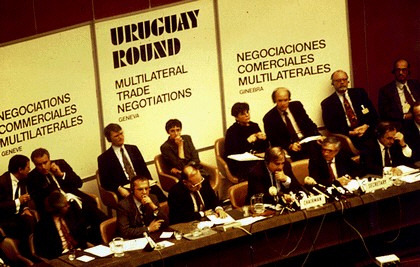
In addition, facing the limitations monetary system due to Bretton Woods system, President Nixon announced the New Economy Policy and adopted fiat money by abolishing the gold standard system. Fiat-money is not based on anything (maybe based on treasury bond), but to put the meaning of the currency itself. So, the volume of money increased rapidly and it played a role in mitigating barriers to the trade. The Uruguay Round negotiations were held and WTO was established. It is to prevent concerns over the spread of protectionism in the previous era as the dependence of the global economy deepened. Here is the rule of it:

- Pursue nondiscriminatory trade
- Concessionary tariff allowed
- Predictable and always accessible to the market.
- Stability in its free trade.
- Encourage fair competition.
- Aid the smooth economic development of frontier and emerging countries.

FTA
Multilateral trade negotiations to support for economic development have begun to feel limited in establishing new order. There was no settlement due to differences between developed countries and emerging markets. It is wiser to have trade negotiations between the countries as an alternative.

Increased free trade agreement (FTA) with bilateral trade negotiations was faster and more efficient than multilateral trade negotiations. FTA eases tariff and non-tariff barriers to promote mutual trade. However, it violates the principle of WTO including multilateral exception clause. However WTO also admits FTA for its value of “laissez-faire trade” or trade liberalization and contribute on prosperity on global economy.