무역, 해외 시장 모니터링, 리서치 및 분석.

레이블이 Markets인 게시물을 표시합니다. 모든 게시물 표시

2020/11/19

Why was Rupiah the most depreciated currency in the world during COVID-19?

 Bank of Indonesia

Indonesia’s central bank has cut its benchmark interest rate (targeting seven-day repurchase rate) at 3.75 percent for two consecutive months. Indonesian bank has reduced its policy rate by 125bp in just 2020 after pandemic hits. Indonesia has chosen untraditional way of monetary policy in the use of tactics of directly financing the government’s fiscal deficit. This is unlike other central banks since they buy the bonds form secondary markets such as commercial banks or financial institutions (for example: Blackrock or PIMCO in U.S.) The direct government bond buying from central bank was possible after a panel of people in parliament recommended a revision to the central bank law.

Investors concern whether the government will have a larger role in the central bank’s policy decision. In the 1999 Central Bank Act, BI have mandates to maintain currency stability and manage inflation by supporting economic growths and jobs. However, as government takes most of the part in central bank’s decision-making, central bank won’t have full right in setting interest rates and issuing new monetary policy.

Rupiah

The rupiah has declined almost two percent this month and more than 6.5 percent in just 2020. The performance of Rupiah was the worst in Asia. I can think of two factors that make Indonesian currency weaken this year: fear of pandemic and BI’s super-dovish stance.

A surge in pandemic in Jakarta has added pressure on depreciation. As foreign investors worry about the fundamental of Indonesian market, they had to cash their assets and exit from there. In the process of exit, investors need to exchange Indonesian Rupiah to their native currency. If demand falls, then the value falls which made Rupiah into devaluation. BI is prompting intervention in the currency market to prevent the outflow of their own currency.

BI has pledged to buy $27 billion of government bonds in the primary market in the condition of relinquishing interest payments as one-off purchase in the reason of $40 billion fiscal expenditure for countermeasure against pandemic in 2020. The yield on 10-year Indonesian government bonds was 7.2%, but BI promised to buy it in higher price exempting interest payment to 0%. This means central bank is printing more money than its actual value. This will lead to more liquidity environment which is vulnerable to their currency value.

Slow Recovery

Recent economic indicators are sending risk signals on the pace of recovery in Southeast Asia's largest economy. Manufacturing and consumer confidence and retail sales data were falling, and exports and imports declined more than expected in August. Dis-inflationary circumstances were caused by sluggish domestic demand in both July and August. Inflation rate has shown a little uptick from last year which is 1.32%. (BI’s target is 2%-4%)

“Finance Minister Sri Mulyani Indrawati said Tuesday the economy could suffer a more severe contraction in the third quarter than previously forecast due to the renewed social curbs in the capital. For the full year, she expects economic growth at the lower end of the government’s outlook, which ranges from 0.2% growth to a 1.1% contraction”, Bloomberg reports.

Central banks in emerging market

Covid-19 has hit worldwide economy; global trade has begun slowing, great lockdowns interfered outdoor travels, corporates had no choice but to furlough workers which led to the rise of unemployment rate. Financial market has also been in a fearful strike as investors worry about their plunging assets. At least, expectation of strong economic growth from advanced countries is good news as many believed that the worst had passed. Their stock market quickly recovered from the bottom point recorded in March.

However, emerging market has different story with the advanced countries. Countries like Indonesia, Philippines, India, Russia, Brazil, and Turkey are in economic crisis as pandemic has been spreading rapidly. Central banks like India, Indonesia, or Philippines have eased their monetary policy which can lead to downwards on their credit ratings. For example, Bangko Sentral ng Pilipinas, the central bank of the Philippines announced that it would implement 300 billion Philippine peso (about $6.2 billion) government bond repurchase agreement with the country's Treasury Bureau for six months at most. Excessive stimulus programs like sovereign debt purchases in response of pandemic recession, can damage central bank’s future cuts and tapering and monetary authorities can lose credibility.

S&P Global concerned that the purchase program does not only result to an inflation problem but also lead to debt issuance surge and currency depreciation. "Sovereigns with less credible public institutions and less monetary, exchange rate and fiscal flexibility have less capacity to monetise fiscal deficits without running the risk of higher inflation”, says the analysts. "This may trigger large capital outflows, devaluing the currency and prompting domestic interest rates to rise, as seen in Argentina over parts of the past decade." S&P has downgraded more than 50 government ratings as level of debt is are set to continue of spiral.

Source: Bank of Indonesia, Bloomberg, The Economist

https://www.bloombergquint.com/onweb/bank-indonesia-seen-on-hold-as-rupiah-pressured-decision-guide

https://www.bi.go.id/

Global Monitor

2020/10/30

Market scenario when Democratic Party sweeps [Blue Wave].

As the US president, one third of the Senate and the entire House of Representatives comes to a close (November 3rd, 2020), a survey found that Democratic Party candidate Joe Biden continues to lead the race against Republican candidate Donald Trump by big difference according to CNN. Reportedly, in a poll of voters who are willing to vote, Biden was leading Trump 54% to 42%. It was analyzed that the gap between the two had been the largest for 20 years. However, we do not know whether the poll is exact or not due to many reasons as some insist CNN is part of Democratic Party supporter. Forecasting which party will take over White House and Congress is fairly impossible. But the guesses of market direction are emerging as polls indicate that Democratic Party is about to sweep.


Bond Market

The scenario that can cause the greatest volatility in the bond market in the short and long term is when Democrats occupy both the White House and the U.S. Congress. If this scenario is comes to reality, the US 10 year Treasury is expected to surge creating bear steepening yield curve. In order to cover the 2 trillion +a stimulus plan, more fiscal budget is needed. Therefore, the government will likely to raise tax and issue additional treasury. Therefore, as supply of government bond increases, the more interest rate is needed to raise the fund for stimulus package.

Stock Market

Meanwhile, a steep rise in Treasury yield is expected to have a negative impact on the US stock market. If tax hikes and new taxation are implemented as Democratic Party's pledge, it will lead to ‘crowding-out effect’ with investors in risk-off stance and a decline in corporate investment. However, there is possibility that stock market would not fall very sharply due to hope in support of policy mix; combination of monetary and fiscal policy. Since the liquidity environment is being floated, the risk of the crowd out effect is not very big deal. The outlook for the stock market is quite mixed due to many possibilities.

Currency Market

The dollar has been weakened mainly due to three reasons: relatively strong Chinese GDP growth has made Chinese currency attractive, investors are buying Chinese corporate bonds (yields are higher than U.S) as Chinese government is steadily in progress in opening their financial market, and expectation of Democratic Sweep (Blue Wave). This can be quite controversial as many investors think that treasury yield increase, the value of currency rise together. However, the yield only applies to market interest rate (usually 10 year). Since Fed is targeting call money rate (short term interest rate), low chance of strong dollar will likely to appear. Fed will continue increase money supply as more stimulus package is needed, therefore, more chance of inflation will emerge, which means real yields will fall more than nominal yields grow. Please check my blog below.

https://techongstudy.blogspot.com/2020/09/real-yield-is-reason-for-market-mover.html

Global Trade

Candidate Biden and Democratic Party's trade pledge does not differ much from the current Trump administration's trade policy. Candidate Biden pledged to promote trade policy that benefits Americans such as labor market. The policy is to recover domestic unemployment rate deteriorated by COVID-19 and strengthens domestic manufacturing industry in the slogan of 'Made in America' and 'Buy American'. “Economic security is national security”. Biden announced to correct China's unfair trade practices and reform China's structure, which undermines the multilateral trade order. The strong policy toward China is expected to continue regardless of the election results.

Source: Saint Luis Fed 

https://fred.stlouisfed.org/series/T10YIE#:~:text=The%20breakeven%20inflation%20rate%20represents,Constant%20Maturity%20Securities%20(TC_10YEAR).

Source: U.S. DEPARTMENT OF THE TREASURY

https://www.treasury.gov/resource-center/data-chart-center/interest-rates/Pages/TextView.aspx?data=realyield


2020/10/27

Which party is better for the stock market?

Two of presidential debates have been proceeded; the two candidates are preparing for the presidential election on Tuesday, November 3rd. The dollar has been weakened mainly due to three reasons: relatively strong Chinese GDP growth has made Chinese currency attractive, investors are buying Chinese corporate bonds (yields are higher than U.S) as Chinese government is steadily in progress in opening their financial market, and expectation of Democratic Sweep (Blue Wave). As Democratic Party has less philosophy on fiscal soundness (stability), the more hopes on stimulus measures and government expenditures are putting dollar on pressure. However, investors often misunderstands that Democratic Party or Republican Party will help the stock price rise.  However, the direction of stock market is not determined by particular party from either bipartisan. The history explains the reason. 

The S&P 500 index originally began in 1926 including only about 90 shares, so called ‘composite index’. Since the appearance of S&P 500, average annual increase rate of Republican Party was 9.3% while Democratic Party was 14.5%. This may look good for Democratic Party. However, The Great Depression and Financial Crisis was a big factor for stock market deterioration during Republican president. As S&P index started, the Great Depression came in three years as president was Republicans (Coolidge and Hoover). Right after the depression started to fade away the stock market skyrocketed 53% during the first year of Democratic president (Roosevelt). It applies similarly to President Obama as stock market surged about 27% during his first year of president right after President Bush, whose stock performance was -37% in the fourth year. 

Excluding these huge fluctuations, the average annual return rate was close to 11.1% for Republicans and 13.6% for Democrats (In fact, except for Hoover and Roosevelt, the Republican Party has been higher than the Democrats.)

Annual yields during the presidential term

The first year has been 8.1%, 9% for second year, 19.4% for third, and 10.9% for the last year. An interesting pattern is that in year 3, stock prices never had low returns except in 1931. And in the fourth year, the negative rate of return was four times including the financial crisis, but often recorded double digits except for that. 

In the first half (first and second year) presidential term, the rate of return is highly volatile. The negative returns is higher than in years of three and four. Investor’s avoiding legislative risks in the first half is the main reason. The legislative risk gives big impact on the stock market. The legislation contains redistribution or regulatory change in property rights. Politicians push for legislation, saying it can bring about amazing social development such as antitrust law and rules based on populism. The coercive policies are implemented in the first and second year which raises more of risk on stock market. Later, legislation risk decreases in the second half of presidential term.

Why is it divided into the first half and the second half? First of all, the meaning of the word politics is ‘poli’ (many Latin words) + ‘tics’ (blood-sucking ticks). Every president thrives to achieve only goal which is to be re-elected. So, most of legislation should pass the congress in the first or second year. That's why midterm elections haven't always had good results (except George W Bush). Most pass legislation within two years of taking office. After that, they passed less than before, and political risk aversion fell to a low level. On third year, the stock market starts to rise. In the fourth year, the average return is good because of some political activities ahead of the election. C the side effect takes place for extreme situation, but the stock market usually outperforms because strong legislation is not passed.

For example, in the first year of Obama, Health Care Reform was promoted, and in the second year, the Dodd Frank Act was passed. However, in the third year, there were no critical legislation except for raising the limit of government debt.

So what do investors or entrepreneurs think? Usually, they support Republicans since they execute business-friendly campaign as many think Democrats are less business-friendly and stock market-oriented. When the Republican president is likely to be elected in the fourth year, the stock price rose 15.6% per year whereas 6.7% rose when Democratic Party is likely to be president. Meanwhile, in the inaugural year of the Democratic president, the stock market rose 14.9% whereas, Republican President rose only 0.8%. Investors commonly think The Democratic Party condemns Wall Street however, they later change into moderate stance regarding stock market in the election year. Don't make Wall Street rich people angry. In other words, just because the Republican Party is in power does not mean that the stock price will rise significantly or that the Democratic Party will significantly decrease. When it comes to dollar, the dollar weakens on election year when Blue Wave is on expectation as Democratic party prefer more government expenditures. Later, the dollar gains its value. Otherwise, when Republican sweep is anticipated, the dollar strengthen expecting of firm fiscal soundness. However, Republican has fiscal deficit later on especially on the Reagan times. Meanwhile, Clinton times had the record fiscal stability. 

Presidents who were not re-elected

Regarding S&P 500 so far, 14 of the presidents have been re-elected, while Ford, Carter, and George H.W. Bush were the ones who failed. In the case of Ford, except for the election of congress member, he has never won any election. The reason that Ford became a president was because President Nixon resigned attributing to Watergate Scandal. Ford, who was vice president that time, became president. Carter defeated Ford and became president. He was lucky to compete for election with the weakest president. But Carter's misfortune, the misery index (calculated by adding the seasonally adjusted unemployment rate to the annual inflation rate) due to oil shock, and the strongest candidate in the Republican Party's history (Reagan, the greatest communicator), failed Carter's tenure. Father Bush had to fight with a slight recession in the fourth year. He was unlucky because he inherited huge budget deficit from Reagan, the former president. FED hiked interest rates to responded to negative impact of previous president's economic policy. As soon as the term ended, the downturn ended, but the best debater in history, Clinton, appeared in the election race. “It's the economy, stupid,” said Clinton who was elected after the campaign of attributing the fourth-year stock market single-digit growth to economic recession. During the Bush era, the economy was not very bad and even though he won the war, he gave the regime to Clinton. .


Source 1: Stocks for the Long Run [Jeremy Siegel]
Source 2:  Markets Never Forget [Ken Fisher]

Source 3: https://www.macrotrends.net/2482/sp500-performance-by-president

Stock price disparity of A- and H- shares in Chinese and Hongkong stock exchange.

深港通 and 扈港通

When trading Chinese stocks through 深港通(Shenzhen-Hongkong Stock Connect) or 扈港通 (Shanghai-Hongkong Stock Connect), we often find companies listed simultaneously on ‘Shanghai and Hong Kong’ or ‘Shenzhen and Hong Kong’ exchanges. Generally, ‘law of one price’ indicates the same product must have the same price applied in any market. However even though the company has the same business structure and performance, the prices of stocks listed on the Shanghai or Shenzhen stocks tend to be overvalued compared to the prices of stocks listed on the Hong Kong Stock Exchange. Why does this happen?

A-Share and H-Share

In order to understand the question, investors need to understand the concept of H-shares and A-shares. H-shares the stocks of Hongkong or Chinese corporates that are listed in Hongkong stock market. Chinese and non-Chinese can trade freely. Meanwhile, A-shares are stocks of Chinese companies that are listed in Chinese market such as Shanghai and Shenzhen stock exchanges, mostly for Chinese investors. Foreign-only stocks are called B-shares. They can be traded by foreigners through the 扈港通 and 深港通 system. However, B-shares are very limited to specific firms. 

The A-H premium index is an indicator that needs to be checked in order to determine the relative price level of companies listed in both markets. The AH Premium Index is an indicator of the relative price gap between Shanghai or Shenzhen A shares and Hong Kong H shares for the same company.

Since A-shares are traded in RMB and H-shares are traded in Hong Kong dollar, AH premium index is calculated at the exchange rate of the day in order to compare in the same currency. If the index exceeds 100, it means that A is relatively overvalued, and if it is less than 100, it means that H is overvalued. 

In the modern financial market, when a price difference occurs due to a temporary market imbalance for the same target, it is a common phenomenon to close the gap through arbitrage trading. The price gap is resolved because transactions are constantly attempted to obtain profits by buying undervalued objects and selling overvalued objects.

Based on this theory, the prospect that the AH premium will almost disappear from the market was prevailing with system of 扈港通 in November 2014. This is because both Chinese and foreigners in China can buy and sell A and H shares.

However, as the mainland stock market continues to fluctuate, the AH premium index has also been volatile, and the price gap has continued to arise during the fluctuation. In the last decade, the AH premium index has moved between in the range of 90-150. 


Why does the price gap between share-A and H occur?

First, capital movement is not completely free due to differences in investment applied to mainland China and Hong Kong markets. In order to be able to trade arbitrage, foreigners must be able to short sell A and buy H shares, but short selling of A-shares is prohibited. In addition, Chinese may have to buy H shares without restrictions through 港股通(Southbound), but individual investors must have 500,000 yuan cash in their stock accounts, and there are limitations in accessibility to investment like such as credit transactions.

Second, the difference in the liquidity environment between the two markets is also causing the price gap. The continued efforts of the Chinese government to open the stock market for foreign capital, such as the implementation of the 扈港通 and 深港通 systems and the expansion of the QFII investment limit, created a favorable environment for the liquidity reinforcement of the mainland stock market. The policy to expand A-share investment opportunities for foreigners is expected to continue.

Third, the difference in the share of major industries between the two markets can be said to be a factor of the price gap. H shares have a high portion of the financial sector at 72%, while A shares have a relatively high share of consumer goods, information technology, and industrial goods that are expected to benefit from the Chinese government's policies. In addition, the willingness to foster mainland Chinese stock markets compared to Hong Kong should be seen as having an impact on price gap.

Finally, degree of perception by investor in both markets such as the direction of the currency rate, and the level of risk-required return can be seen as factors affecting the A-H premium and the gap between the two markets.

According to the Hang Seng Stock Connect AH Premium Index, as of September 2020, companies that were simultaneously listed in China's A-shares and Hong Kong's H-shares are trading at 43% lower levels in Hong Kong's H-shares.

Source: Investopedia

https://www.investopedia.com/ask/answers/062315/what-are-differences-between-hshares-and-ashares-chinese-and-hong-kong-stock-exchanges.asp

2020/10/22

Bank of Israel is to increase bond purchase and remains interest rate at 0.1%.

The central bank of Israel announced to hold interest rate at 0.1% with expansion of its government bond-purchase by NIS 35 billion ($10.3 billion) to stimulate economic activity and to stabilize the financial market.  

The central bank assumes the nation's GDP to decrease by 5% in this year, and contract by 6.5% in the following year (2021). The forecast applies when the nation is taking effective countermeasures against the pandemic. However, in the worst case, the economy is expected to shrink by 6.5% in 2020, and grow by 1 % next year.

Central bank’s purchase can help Israeli’s small business

Bond purchasing program will expand to NIS 50 billion in the secondary market to ease credit terms and to stabilize and support financial market and economy. Government bond purchases totaled about NIS 33.6 billion until September, according to central bank. The Monetary Committee, which is part of Bank of Israel for achieving the Bank’s objectives (mostly monetary policy), launched new programs of NIS 10 billion to support small business. The bank will provide fixed interest rate of negative 0.1% for commercial banks to encourage the loans for small and micro business. 

The number of unemployed became 470,000 in the first half of September due to the lockdown. The inflation rate in the past 12months has dropped by 0.7%, which is in need of support of policy mix programs.


Source : The Times of Israel

https://www.timesofisrael.com/bank-of-israel-leaves-interest-rate-unchanged-at-0-1-to-increase-bond-purchases/

2020/10/18

Zambia is now on default crisis on its dollar-denominated bonds.

Zambia, one of the African nation which has GDP (2019) of 23.06 billion U.S. dollar, is likely to announce its default on the onset of pandemic crisis. The country has delayed to pay its interest on dollar-bond and it may be the first example to prepare for default. 

According to reports, Zambia has requested a six-month suspension of interest payments from US$3 billion dollar creditors, but has been denied. Ahead of next week's meeting, these creditors have already expressed their position not to accept Zambia's request. 


Zambia's Finance Minister said, "If the agreement with creditors fails, interest payments will not be possible with Zambia's limited fiscal capacity, and interest delinquency will not be avoided,". It implies the possibility of default.

Zambia is the world's second-largest copper producer, and has attempted to adjust its external debt to a total of 12 billion dollars amid the economic shock from Covid 19. Copper is an indispensable raw material for the industry, and prices fluctuate significantly responding to the downturn of global economy.

The interest due is on the 21st is about 42.5 million dollars. Generally, if interest is not paid after 30 days, it is classified as a default bond. It is reported that creditors' reluctance to postpone the deadline is due to concerns that they may be burdened unfairly. 

Some of the creditors on the Chinese side have pressed Zambia to ask for interest in China in order to agree on a delay, and Zambia is said to be refusing it. About one-third of Zambia's $12 billion in foreign debt comes from China.

Bondholders want Zambia to enter the IMF's bailout and economic improvement programs. However, Zambia's debt is so high that it is far beyond its eligibility for relief. Since the general election is about 10 months ahead, the possibility of massive fiscal cut is uncertain.  

Source: Global Monitor

https://now.globalmonitor.co.kr/view.php?ud=2020101522480969391a6a872ef5_41

2020/09/19

Stock market seems decoupled with economy: 5 reasons to explain.

Worldwide pandemic strike has later resulted asset market melt-down. The factories in China had labor shortages which reduced global supplies. After the COVID-19 punched American and European countries, the biggest shutdown or so called 'Great Lockdown' in world history, their demand has shrank extraordinarily enough to slow down international trade. The fear of loss of demand and supply would bring to the exacerbation of world economy and the stock responded accordingly. The coronavirus recession, which seemed like a bear market rally, has led to investor disposition effect. Margin calls negatively granted fear to investors to sell off their assets. 

However, the asset market such as stocks, bonds, and commodities, and so on started to revive while the fundamentals were still low. The media has attracted attention to the stock market in which mom-and-pop investors could have opportunity to buy the stocks cheaply from the lessons of dot-com bubble and great recession in 2008. The sensation so called 'FOMO (fear of missing out)' triggered melt-up markets. See my blog https://techongstudy.blogspot.com/2020/08/fomo-fear-of-missing-out.html

However, why does this phenomenon happen? What made the ‘fear of having asset’ to ‘fear of missing out’? Why are there so many day-traders (or sometimes called momentum traders) who think they can beat the stock market?

1. There is no alternatives (TINA)

The great shutdown has halted sports games to prevent people from mass gatherings. Sports association did not intend to cease but to sustain the games without crowds. However, as sports stars were exposed to the disease, the games were more than a month delayed. Quarantining at home as lockdowns continues, gamblers were seeking for attractive and thrilling bets. Dave Portnoy was at the lead, showing off his gains through selling and buying stocks. Robinhood investors were deceived by ‘mister market’ (which Benjamin Graham introduced) and started their speculative activities. The liquidity from sports gamble to the stock market has moved the index upwards. 


2. Signals for economic recovery

Crowds believed that the worst has passed. As stock market index is a leading indicator to the economy, multitudes assumed in a strong bounce back. More positive news on real economy such as PMI or unemployment rates are alluring mom-and-pop investors to the market. Anticipation on corporate earnings recuperation can be a strong reason for holding the shares in case of rising in the future. “If the economy continues its recovery and real GDP growth is anywhere close to the current consensus view, the stock-market bull may just be getting warmed up”, says Jim Paulsen, chief investment strategist at Leuthold (WSJ). 

3. Monetary Policy

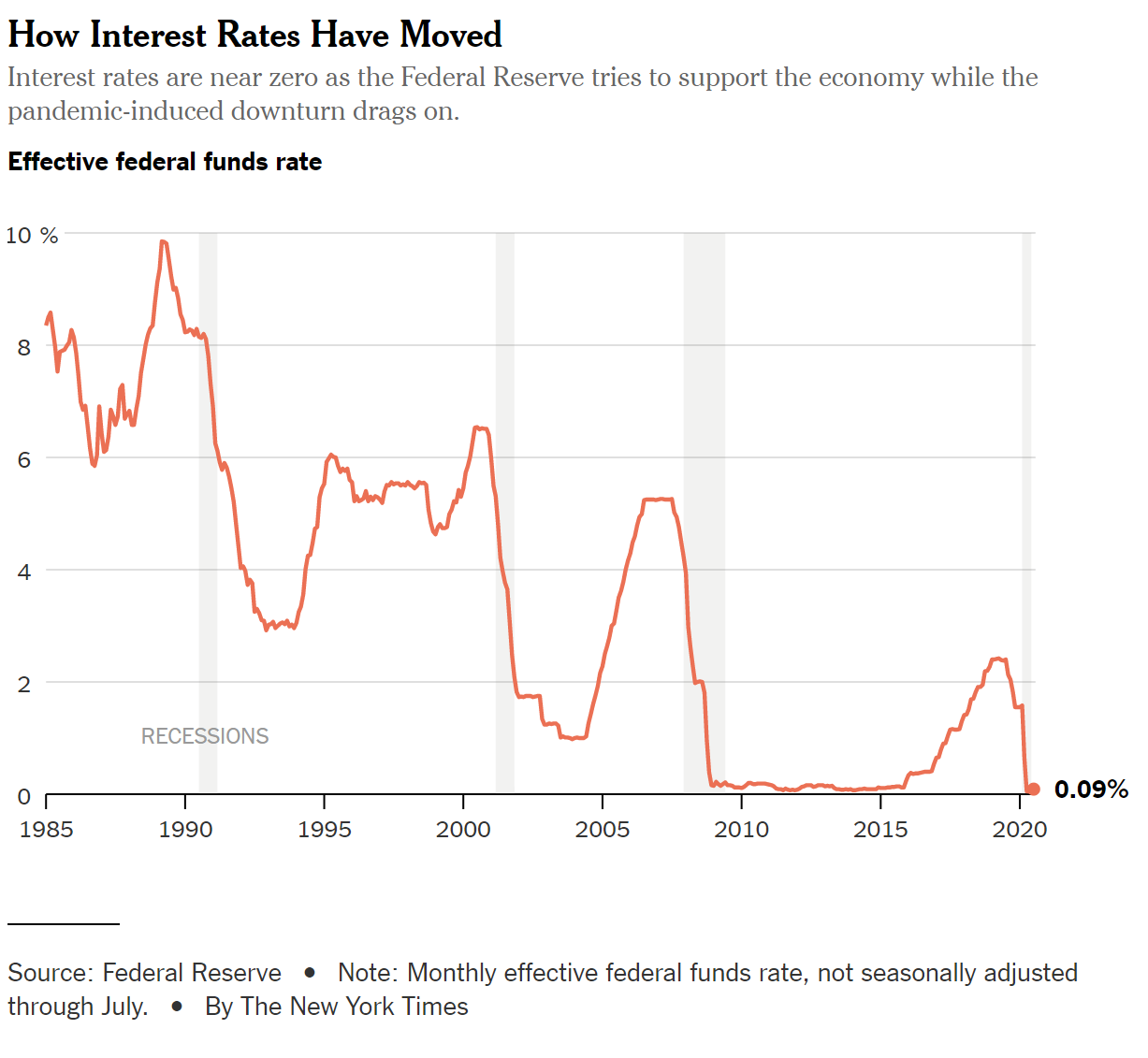
Federal Reserve and U.S Treasury have been responding to the pandemic crises more rapidly than the previous catastrophes such as financial crisis in 2008 or great depression in 1929. Fed has cut its federal funds rate to near-zero and reported its lending powers by financing into special purpose vehicle (SPV) leading market reflation. Low interest rate is good for ‘gold-and-silver class’ wealthy people since they borrow money at discounted price and invest on asset markets to seek for more wealth. According to the Federal Reserve about top 10% of wealthy Americans owned 87% of all stock in the first quarter. Also, the banks seem to lend cash in accordance with reliability and ability to pay back. Moreover, low interest rate results in low real yield of treasury bills, notes, and bonds (regarding inflation), which would boost asset market such as stocks and gold to benefit more gains. See my blog: 

https://techongstudy.blogspot.com/2020/09/real-yield-is-reason-for-market-mover.html. 

However, this does not only apply to Fed but also to Bank of Japan, European Central Bank, and the banks all over the world. BOJ and ECB both revealed to give incentives to the commercial banks whenever their lending activities to the firms outperforms. Programs such as SLF, PEPP, TLTRO III were announced to bring the stability of their asset market.


4. Fiscal Policy

U.S. Department of Treasury has announced fiscal policy, CARES Act, which “provides fast and direct economic assistance for American workers and families, small businesses, and preserves jobs for American industries.” This includes PMCCF or SMCCF, MNLF, etc. Companies such as YRC, MCH, and Juniata received bailouts of loans from government. Lending programs such as 150 million stimulus package and payroll protection program were also revealed by U.S. Treasury, helping for firms to maintain employments or furloughed ones. HEALS (Health, Economic Assistance, Liability Protection and Schools) Act was additionally mentioned. These are later having ‘announcement effect’, which means Fed's bond-buying program (CCF) has affected investors’ psychology to buy the assets believing lending program will help them buying later according to New York Fed’s report ‘It’s What You Say and What You Buy : A Holistic Evaluation of the Corporate Credit Facilities’. “The effect of the programmes is more psychological than financial... The Fed has totally achieved their target.” 

5. Dominance of Tech Giants

The out-performance of the tech giants laid the disparity between the stock market winners and losers. The gap between them has resulted inequality in the market; companies which concentrate on contactless business such as Paypal, Shopify or Zoom had best performances during the pandemic since many people were staying at home. However, energy, financials, utilities, real-estate and industrial segments were still in the red. Most of tech giants have market capital dominance, which makes stock markets such as Nasdaq and S&P 500 moving upwards since the index is calculated in weighting method, giving a higher percentage allocation to companies with the largest market capitalization. Big market capitalization is dominated by companies with contactless business tools which makes stock market inflated.


Source

https://www.visualcapitalist.com/how-big-tech-makes-their-billions-2020/

https://research.stlouisfed.org/publications/economic-synopses/2020/04/21/central-bank-responses-to-covid-19

https://www.wsj.com/articles/why-did-stock-markets-rebound-from-covid-in-record-time-here-are-five-reasons-11600182704

https://www.wsj.com/articles/should-you-buy-stocks-because-interest-rates-are-low-11600263713

https://www.wsj.com/articles/when-the-stock-market-and-economy-seem-disconnected-11598002220

https://www.wsj.com/articles/this-market-is-a-tech-market-if-bond-yields-rise-watch-out-11598101689

https://www.marketwatch.com/story/robert-shiller-explains-the-pandemic-stock-market-and-why-its-decoupled-from-the-economy-2020-07-07

2020/09/10

ECB's dilemma on the rise of Euro

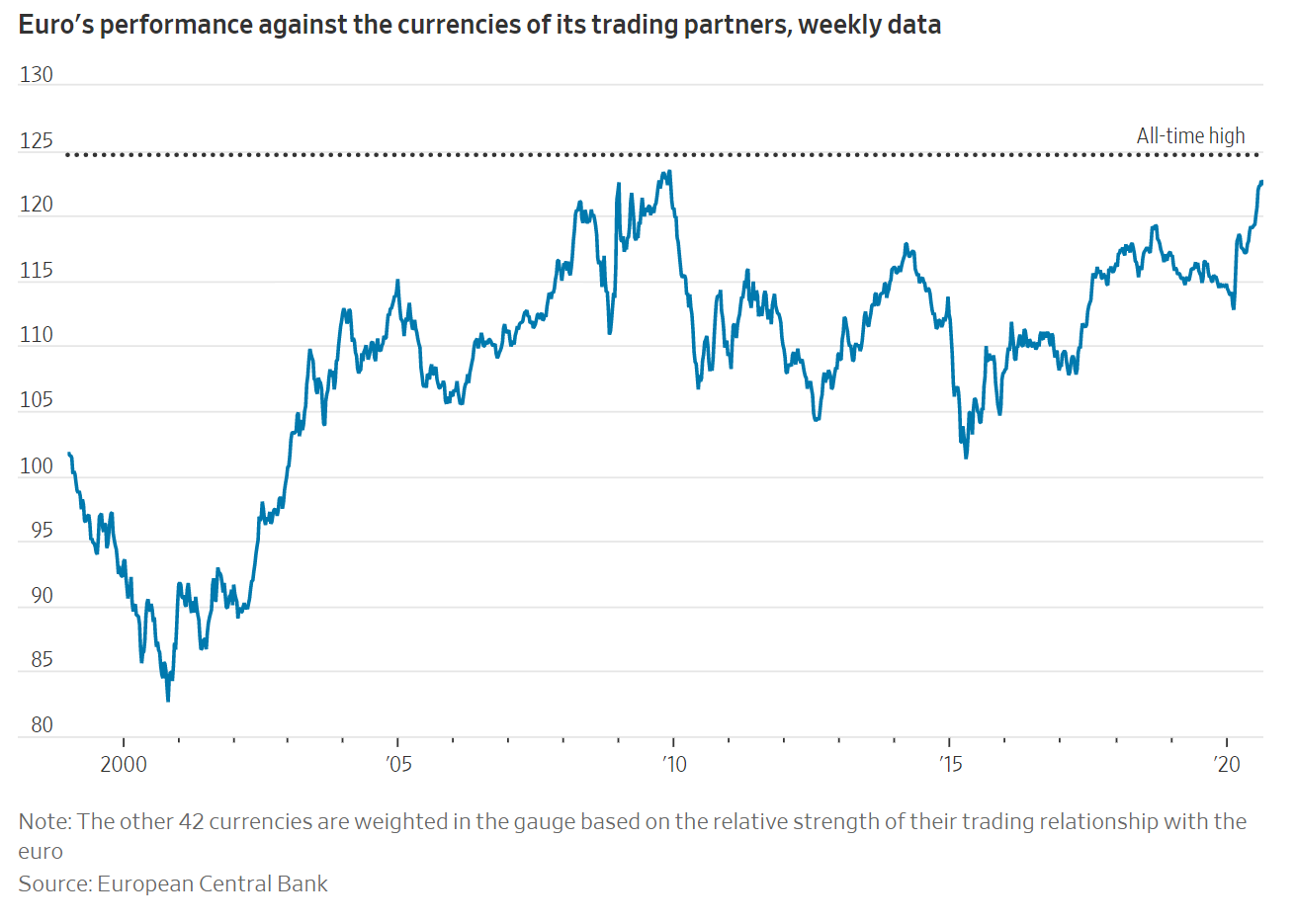
The euro has been surging 10% against U.S. dollar in six months in part because investors think Europe is strongly performing economic rebound after the great lockdown due to  pandemic. The bet on European stocks rise has been increased and and investors have kept buying euros in the aspect of optimistic sign of euro-zone recovery. U.S dollar has been weakening in the announcement that Fed will remain its super dovish stance of maintaining federal fund rate near zero until average inflation target(AIT) overshoots over 2% moderately for some time. Please see my blog about it.

https://techongstudy.blogspot.com/2020/08/review-of-monetary-policy-strategy-fed.html

U.S. is still struggling with pandemic now; indicating countermeasures weren't very appropriate enough to flatten the curve. Moreover, uncertainty about new cold war between U.S-China, and anxiety about the presidential election in November makes investors unease. These factors make the dollar weaker than the counter-parties such as Japanese yen and euro. 

Eurozone's rapid recovery could be a good sign, however absolute growth alone could stimulate the euro's jump; that means it can hurt inflation target near 2% and European manufacturers from exporting. A strong euro contributes to the risk of deflation or dis-inflation because imported goods become cheaper for European buyers. Moreover, when it comes to export, goods will automatically become relatively more expensive for international customers who pay in other currencies. The price disadvantage will put them in worse condition to compete against foreign rivals. 

Even before the pandemic, exports from European started stagnating due to the global slowdown whether it is directly and indirectly affected by the trade tension between U.S. and China. The Trump administration has imposed tariffs to European commodities such as steel and aluminum. Also, spread of Chinese economic deterioration created less demand on European goods.  European based companies like Ferrari, Fiat-Chrysler, or Michellin will get profit hit with appreciation of their currency. 

“There is a cost to the euro rising, and it’s on earnings,” said Mathieu Savary, a strategist at BCA Research. “If you’re a European industrial company and you compete with Caterpillar, you’re likely to see your profits being hurt when the euro is going up.”  Other trading partners including U.S. and China can benefit from strong euro by taking advantage of their relatively weaker currency.

European Central Bank did not change their interest rate at -0.5% and would support €1.35 trillion, equivalent to $1.59 trillion, of eurozone debt under an emergency bond-buying program unveiled in March. The ECB now aims to keep inflation in average of 2%.

Stronger euro is problem to eurozone. It would not meet the target inflation rate and hurt their export industry. However, ECB does not have enough ammunition to lower the key interest rate nor provides fresh new stimulus program, which is already massive. The central bank does not directly target the exchange rate, but should concern about it in regarding to their economy.  

Source WSJ, NYT

https://www.wsj.com/articles/ecb-leaves-policy-mix-unchanged-as-it-monitors-covid-19s-impact-on-economy-11599738872

https://www.wsj.com/articles/companies-brace-for-profit-hit-from-euro-rally-11599473390?mod=searchresults&page=1&pos=7

https://www.nytimes.com/2020/09/10/business/ecb-euro.html

2020/09/06

Bigger correction of the market after fierce rally? Watch out for the market overhang.

Stock splits have let Apple and Tesla perform high right after the announcement. Apple has split 4-for-1 and Tesla 5-for-1 last week. Please see my blog about stock split down below link.

https://techongstudy.blogspot.com/2020/08/stock-split-and-your-portfolio.html?m=1

However, stocks of Apple and Tesla each fell more than 17% and 23% which could be a sign for bigger correction as investor fears of great leap will be adjusted. Some of the investors worry about double dip since the market is rallying fiercely from March whereas the real economy is now on slow pace of recovery. Quick response on monetary and fiscal policy has eased the financial market by purchasing corporate bonds, ETFs, and so on. With the announcement effect from Fed, investors were full of greet to purchase the assets hoping financial market would be rebounded with the back of abundant liquidity and bank lending programs. Howard Marks concerned money printing will lead to investor’s FOMO syndrome which will drive risky market melt-ups. See my blog about FOMO.

https://techongstudy.blogspot.com/2020/08/fomo-fear-of-missing-out.html?m=1

James Mackintosh points out three areas about dangerous signs of the market rallies: “overly optimistic sentiment, the impact of options trading, and the speed and scale of the rise of leviathan technology stocks. It is not only mom-and-pop investors but also Softbank, one of the leading investment companies on IT sectors, has rushed $4billion on option trading to participate the market rally.

Perhaps, pessimists say that whereabouts now are similar to the dot-com bubble in early 2000s which Nasdaq has experienced sharp price crush. The lesson from the great burst has “rediscovered the value of caution, and put option (act of selling) became popular again” for the past 3 days’ market movements. Still, optimists say the mega tech companies are prospering with high profits in their balance sheet. The danger isn’t as prominent as so many dot-coms in the past. Still, investors should be cautious to estimate the value of the stocks since S&P 500 Shiller CAPE Ratio (way of measuring price earning ratio) now is over 30. Of course, it is not easy to measure the value of each stocks, since there are many variables to measure, however, let’s put in to Warren Buffett’s shoes pondering “Will he buy that stocks?"


2020/09/05

The Global Economic Crisis from China Has Started

“There is an opportunity that comes once every 100 years"

The global economic crisis from China has already begun, and a book has been published in Japan by two renowned economist, Miyazaki and Tamura, claiming that this crisis has an opportunity that comes once every 100 years. The new book “The Global Economic Crisis from China Has Started” explains the cause of the crisis from China, which will bring more shock global financial crisis 2007-2009, and suggests concrete method to find opportunities in this crisis. The global economy in 2020 is likely to be a more difficult year than ever in history. It is because there is a high possibility that the economic crisis caused by inflation from China, which has been constantly raised so far, will become a global economic crisis in the aftermath of the US-China trade war.

Unlike what appears to as trade war due to U.S. trade deficit, the essence of the U.S.-China trade war is the war of technological hegemony. In the empire of IT or IoT represented by tech companies so called MAFAA (Microsoft, Apple, Facebook, Alphabet, Amazon), VS AT (Alibaba, Tencent), it is  a fight to take control of technology hegemony. U.S. cannot afford to let China dominate such an important future industry. However, China also has to revert their industry from traditional manufacture industry which produces little profit to the high value-added industry.


China 2025 (Smart Manufacture+) is the best project for China from avoiding in debt-ridden environment and raise its GDP. The problem is that Japan and South Korea are the most affected countries in the U.S.-China trade war over global economic hegemony. Korean investors must come up with strategic countermeasures in case the friction between the U.S. and China continues. This is to minimize the damage and take advantage over opportunities. The book mainly focuses on the risk, which is steadily arising from U.S. and China trade disputes such as China's OBOR (BRI) policy and China Manufacturing 2025, and internal issues in China.
See my blog: https://techongstudy.blogspot.com/2020/08/china-wants-to-revitalize-its-domestic.html

Fighting for techno-hegemony
The background of the trade war began with a number of complicated reasons, in which China has made rapid progress in attracting technology and capital from around the world to become a technology powerhouse that surpasses the U.S. based on a huge trade surplus. As, Chinese exports have been blocked due to the trade war, China is concentrating its domestic economy mostly in technology area. The U.S. government found that it used all sorts of methods, such as corporate espionage and acquisition of foreign companies, such as technology theft and human resources transfer. Recently, as China's ZTE and Huawei (Tik Tok recently) have begun to outpace U.S. technologies in semiconductor and telecommunication technologies, which are key technologies in the future. The dispute between the U.S. and China has intensified as U.S. has pressured China in the form of competition for technological hegemony. This is said to be the same in both partisans (democratic and republicans).

Chinese leader Xi Jinping will never end his presidency by extending his term indefinitely in the National Assembly in 2018. China is expanding its belt and road initiatives with its huge trade surplus capital against the U.S. as a weapon. Before Trump administration, many of the Wall Street-linked relatives and politicians who sought wealth through 'China capital'. After entering the Trump administration, China's prestige grows and threatens the United States. The way to stop it at the source is to intervene in Chinese trade surplus that attracts enormous wealth of China.

Belt and road initiative
The book provides detailed examples of the problems of China's RBI development project. Common problems are that China lends money to emerging and frontier countries through RBI. Projects are monopolized by Chinese companies, major equipment is imported from China, and Chinese laborers are used. The debts leased to developing countries are marked in dollars and carried by the local government. If the debts cannot be paid off, China confiscates the infrastructure or land. The United States recognizes the seriousness of the matter, and Vice President Pence warns of this plan as a 'debt trap'. China is even building a military base (Djibouti, Africa) through this project. In the one-on-one plan, there is a new version of Silk Road intention to secure crude oil in preparation for an upcoming military conflict. Countries that are trapped in debt by OBOR are Pakistan, Sri Lanka, Cambodia, Maldives, Myanmar, Bangladesh, Malaysia, Indonesia, Nicaragua, Venezuela, Thailand, Nepal, Angola, Madagascar, Uganda.

RMB and inflation issue
Issuing more RMB than US dollar reserves, can lay concerns about inflation sooner or later. On the one hand, the United States and Japan support China appropriately, fearing the impact on the world if the Chinese economy collapses. Mainly Japan plays this role because Japanese policy interest rate is negative, so most of Japan's funds are invested abroad, and are borrowed from China through Panda bonds.
"A Panda bond is a Chinese renminbi-denominated bond from a non-Chinese issuer, sold in the People's Republic of China. The first two Panda bonds were issued in October 2005 on the same day by the International Finance Corporation and the Asian Development Bank." - Wikipedia

Japan is also well-known in having massive fiscal deficit, but the authors say that Japan's debt is near zero according to the balance sheet. (Japan is the biggest net creditor country in the world) Unlike the high debt rates of the U.S. and China, Japan has a high savings rate, so financial assets such as deposits and stocks are said to be three times the GDP. (Most of debt-holder is BOJ and its nation) 

Covid-19
Currently, China is not only facing pressure from the United States, but also neighboring countries such as India. There is also internal problem in China as growing sign of dissatisfaction with the government has started to emerge and Covid-19 crisis has triggered it.

Will China collapse in crisis? Well, the paradigm of dispute has reverted from trade tariffs to national security and diplomacy problem after first U.S. and China agreement and pandemic. This book shows historical events through specific examples and data. Global investors are very exposed to the relationship between United States and China; reading this book can serve as an opportunity to seriously think about how to catch global economy trend and prepare for it.

Why is onion future price so volatile?

What makes the market volatile? 
Why is the price of asset so fluctuating?
Is it because of speculative day-trading investors?

The article of <Newsweek> in 2010, mentioned about volatility saying, "By trading vast amounts of stock at warp speed, as many as a billion shares a day, high-frequency traders gobble up fractions of cents at a time. The more volatile the market, the easier it is for them to make money jumping in and out of stocks across exchanges."

Well, does high-frequency trade affects on the volatility on the market? Ken Fisher, CEO of Fisher Investments, indicates volatility during the Great Depression. The stock market was moving upwards and downwards frequently. The reasons for market surge and stumble in short period of time were various; one of them was regarded as lack of liquidity. There weren't that many listed stocks in the market and the trading volume wasn't abundant. Information was delivered much more slowly, which hindered the fast recovery of price. Markets with low trading volumes are usually highly volatile due to insufficient liquidity and supply.

Futures traders are often referred as speculators because they bet money on future prices. There are countless reasonable motives to have future trading deals. Firms use futures contracts to stabilize the cost of purchasing in response of highly volatile commodities. Airlines buy oil futures to stabilize operating costs. Farmers use future tradings to purchase agricultural manure or compost.

Why is onion future price so volatile
If you are curious about a market without speculation, just looking at the onion future market is enough. In 1958, onion farmers claimed speculators were slashing the price of onions. Michigan Congressman Gerald Ford, who later became president of United States, believed in this claim and banned futures contracts for onions. In fact, Ford was the one who has believed in the free market. This ban is not abolished and still exists today. Ford and the farmers did not understand that speculators were contributing to providing liquidity to the market. They didn't even know that their market participation actually makes volatility less.

Onion vs Oil
If you think oil future has heavy volatility, please refer to the chart below. Onion prices fluctuate more frequently than oil prices. The range of fluctuation of onion is even greater. If the price volatility was so high, speculators would need to be invited back to the market to reduce volatility. It is foolish to ban speculation just to protect farmers.


Speculation in forex market
The exchange rate must have a sufficient amount of supply and demand to determine the appropriate exchange rate in the foreign exchange market, which is determined purely by market function, and speculative foreign exchange transactions must exist in order to secure such demand and supply. If speculative trading is prohibited and only underlying transactions are made on demand, the size of the market will not reach a certain level and as a result, the foreign exchange market's exchange rate may be distorted or the exchange rate-setting function may be lost.
For example, lets presume that only underlying transaction is on demand. When the demand of dollar is 2 million and supply is only 1 million, the currency rate will soar up in need for more supply, which will make Forex in extreme volatility.  However, when speculative transaction is traded actively, then the supply problem will be hugely diminished.

Please refer to the blog here:
https://techongstudy.blogspot.com/2020/08/what-is-exchange-rate-and-forms-of-it.html

Source: Market Never Forgets (Ken Fisher)


2020/08/28

Review of Monetary Policy Strategy. Fed won't hike FFR in preemptive manner until inflation target hits above 2% "over time".

STATEMENT ON LONGER RUN GOALS AND MONETARY POLICY STRATEGY

"U.S. economy will struggle against dis-inflationary pressures" - Jerome Powell


"The goals of monetary policy are to promote maximum employment, stable prices and moderate long-term interest rates. By implementing effective monetary policy, the Fed can maintain stable prices, thereby supporting conditions for long-term economic growth and maximum employment.." - Federal Reserve

Fed Chairman Jerome Powell delivered a speech at the Kansas City Fed’s annual Jackson Hole policy symposium on 26th of August under the theme of "Monetary Policy Framework Review."

The Jackson Hall Meeting, a conference of renowned economists, is one of the annual events that attracts the most attention to the world every year. This is because the chairman of the Fed attends and presents directions for future interest rate policy.

The event is drawing keen attention as it could make remarks regarding the Fed's review of its interest rate policy for a year and a half. Considering on the continuing changes economic environment, the Fed said it will review its current rates so far and re-establish future policy directions.

“Our revised statement emphasizes that maximum employment is a broad-based and inclusive goal,” Mr. Powell underlined. “This change reflects our appreciation for the benefits of a strong labor market, particularly for many in low- and moderate-income communities.”

Interest rates will not be raised even if the inflation rate exceeds 2%.
The Fed's most likely review is the abolition of its previous "2% inflation target" adopted in 2012. The Fed saw 2% as price levels that induce growth without adversely affecting the economy. They responded by raising interest rates if prices were likely to rise higher than 2%.
The inflation rate in the United States has been well below the threshold for the past eight years. When the unemployment rate fell, the demand for labor increased and wages and inflation rose. Despite the low unemployment rate, wages did not rise and prices hit the bottom due to the low growth trend and technological innovation.

Fortunately, central banks around the world were able to lower their policy rates to a record low in response to the economic slowdown without worrying about rising prices.

However, growing concerns about low inflation troubled Japanese economy over the past two decades and Europe for a decade, which means when low prices continue and people think that prices will fall further than they are now, could spread by cutting back on consumption. If the economy gets worse here, there's no way to do anything about it anymore. (This is the reason why Japanese government bond were popular among its nation even though the yields were near zero. Almost 90% of Japanese nation holds their government bond which won't damage severely despite their fiscal deficit is over 200%. Greek situation is unlike Japan since they have foreign debts.)

The Fed mentioned about "average inflation targeting" that will have an average inflation rate of 2 percent "over time". Despite inflation rate reaches at 2%, Federal Reserve will remain short term interest rate pinned near zero for a while. PCE(personal consumption expenditures price index), which determines whether the Fed reaches its inflation target, rose only 0.9 percent in June after rising 1 percent in May. Experts predict that prices of some food and meat, which have been hit by supply chains in the aftermath of COVID-19, may rise, but not enough to reverse the low price trend.

Policy focus, price stability, employment and economic stability
It is not new that Powell and other Fed officials stressed job security by mentioning low inflation rate. It is more than a one-time comment because it means that the government will maintain this stance no matter how the economic situation changes in the future.

The Fed's policy focus is expected to shift completely from inflation stability to job security and economic growth. (So called dual mandate) Lewis Alexander, chief economist at Nomura Securities, said the Fed would not do anything that would put a damper on the job market unless it causes unfavorable inflation.

Some worry that the Fed is trying to play a policy role beyond its capabilities. "The monetary policy is approaching its limits," Paul Ashworth of Capital Economics, the U.K., said. "We don't publicly acknowledge it, but we can see that they are demanding stronger fiscal policy from the U.S. Congress."

Treasury bond yield rises
The implications of the announcement weren’t immediately clear for bond investors. The Fed’s long-telegraphed strategy means the central bank will likely leave short-term interest rates near zero for years to come (call money rate), an outcome that by itself should support demand for Treasuries. At the same time, higher inflation erodes the purchasing power of bonds’ fixed payments, potentially making longer-term bonds less appealing.

Following their initial drop, bond yields turned higher as investors focused on the less supportive aspects of the Fed’s policy, analysts said.

Aiding the move: the Fed didn’t commit to buying more longer-term Treasurys as part of its inflation strategy. That disappointed some investors who are concerned that the Fed’s current purchases could be overwhelmed by a deluge of new debt entering the market as the federal government funds efforts to revive the economy. (If Fed buys long term bonds, then there will be problem of austerity)

Source: Federal Reserve
https://www.federalreserve.gov/monetarypolicy/guide-to-changes-in-statement-on-longer-run-goals-monetary-policy-strategy.htm?fbclid=IwAR2vh7TkdObo6GRhihOX_r7bLBFMm9qEwOnai3vU-1yRDUYLeHWTUJ6ECmY

Source: Global Monitor
https://www.globalmonitor.co.kr/view.php?ud=2020082005303583651a6a872ef5_41

https://mobile.globalmonitor.co.kr/view.php?ud=202008200658229728915ce92b70_41

Source: New York Times
https://www.nytimes.com/2020/08/27/business/economy/federal-reserve-inflation-jerome-powell.html

Source: CNBC Television

2020/08/13

Stocks close lower despite the fall of unemployment rate? "Good is Bad"

U.S stocks slides amid the good news of declining unemployment rate. Why can it be possible? In Morning Brief session from Global Monitor mentioned a phrase, "Good is Bad". The good news can be bad news.

According to Department of Labor, initial jobless claims decreased to 963K from 1,191K ending a 20-week streak of results above 1 million. However, investors are concerned if job gains recovers, fiscal booster of giving extra $600 (stimulus package) will decline.
 

The S&P 500 has flirted with record levels in recent days but ended Thursday’s session down 6.92 points, or 0.2%, at 3373.43, still within 0.4% of its Feb. 19 record. The Dow Jones Industrial Average dropped 80.12 points, or 0.3%, to 27896.72, while the tech-heavy Nasdaq Composite index rose 30.27 points, or 0.3%, to 11042.50.

The yield on the 10-year U.S. Treasury note ticked up for the fifth straight session, to 0.714% Thursday from 0.669% a day earlier amid weak demand in a $26 billion auction of 30-year bonds. (Bear Steepening: 30-year bond yield has climbed due to less than expected demand for Conversion Issue)


In commodities, gold rose 1.1% to $1,956.70 a troy ounce as the volatility seen in recent days continued. “We keep gold because there are still uncertainties, real rates are low, inflation may be higher than expected,” said Luc Filip, head of private banking investments at SYZ Private Banking.

According to Professor Jeremy Siegel, bond yields will go higher in 2 or 3 years due to inflation. Investors will not seek for safe-assets, which means they will find riskier assets that compensate by providing higher returns. Inflation hedge assets such as Gold or TIPS can be one of them, stocks or high yield corporate bonds will be another.


Source 1: Weekly Unemployment Claims Drop Below One Million for First Time Since March
https://www.wsj.com/articles/unemployment-benefits-weekly-jobless-claims-coronavirus-08-13-2020-11597280120?mod=hp_lead_pos3

Source 2: Stocks Close Lower Despite Fall in Jobless Claims

Source 3: Global Monitor Morning Brief

Source 4: I think we're going to have a spending boom in 2021: Wharton finance professor
https://www.youtube.com/watch?v=4oTFgqCXcyY

U.S. Treasury yield recovers, challenging gold and silver's rally

U.S. Treasury yield rose on Wednesday in the NYSE bond market to 0.669% for the fourth straight session.

The yield's climb can be considered as the reason below.
1. Consumer Prices(CPI) and Core CPI(excluding foods and energy) each surged for 0.6 percent in July, the same increase as in June. Here is brief explanation of CPI from Investopedia.com. "The Consumer Price Index (CPI) is a measure that examines the weighted average of prices of a basket of consumer goods and services, such as transportation, food, and medical care. It is calculated by taking price changes for each item in the predetermined basket of goods and averaging them."
2. It was triggered by bond dealers' offering of new bonds, with their holdings and fund managers leaving room in their portfolios.
3. The decline in trading volume during the summer vacation season in the U.S. and Europe is also likely to have contributed to the decline.

The rise of treasury yield has curtailed investors's appetite of craving for Gold and Silver, which means that cash looks more attractive.

Source 1: Treasurys Stabilize After 10-Year Note Auction

Source 2: Rising Treasury Yields Challenge Precious Metals Rally

Source 3: Consumer Prices Surge Again, Core CPI Jumps Most Since 1991
https://www.thestreet.com/mishtalk/economics/consumer-prices-surge-again-core-cpi-jumps-most-since-1991

2020/08/12

Can Gold and Silver be considered as safe-haven asset or great hedge against inflation?

Gold and silver have been attractive asset to the investors recently as the central bank policy interest rates have been low after the emerge of COVID-19. It is considered as 'must have' assets among Robinhood due to their portfolio diversification.
In WSJ article, Jason Zweig calls Gold as yellow metal. Gold looks cheap for investors since they regard gold as extremely safe-assets. This ETF related to gold this year values nearly $215 billion; which is about 2 time more than a year ago. Around one-fifth of cash inflow to the gold asset has been made since January 1st 2020 as reported by World Gold Council.

Gold itself do not go up or down in its own value. The value of gold is relatively determined by the interest rate of cash. That means if Federal Fund Rate is set to be higher, then the value of cash follows that. (Interest rate means price of cash) If cash value increases, then the price of gold becomes relatively low. Gold shines brightest when the phase of inflation soars up due to devaluation of cash.

So investor regarded gold as 1. great hedge of inflation and 2. safe-haven assets. If economic downturns take place, people will look for gold. It makes sense however, not always. If the price of gold becomes relatively higher than other assets, then the price might fall due to the overheat of it.

I do not think gold and silver as very attractive assets than the stocks or bonds since it has storage cost, however produces no income like dividend or coupon(yields). The price of gold is also very uncertain against the economy. When economy recovers up and central banks pushes interest rate higher, then it will hurt gold. 

The similar characteristic asset that gold have would be TIPS (Treasury Inflation Protection Security).

However, I do not raise any problems about the possession of gold for the investment diversification.

Source 1: A Golden Rule From a Golden Fool
https://www.wsj.com/articles/a-golden-rule-from-a-golden-fool-11595599207

Source 2: Silver vs. Gold: How the Two Metals Compare as Investments
https://www.wsj.com/articles/silver-vs-gold-how-the-two-metals-compare-as-investments-11596899825

Source 3: Why Gold Prices Are Hitting All-Time Highs
https://www.wsj.com/articles/why-gold-prices-are-hitting-all-time-highs-11596533550